Endurance Echoes: Mapping Prolonged Contests Across Soccer Overtimes, Tennis Marathons, and Stamina-Driven Races to Build Layered Multi-Bet Sequences
Eden Berger · Sep 22, 2026
Endurance Echoes: Mapping Prolonged Contests Across Soccer Overtimes, Tennis Marathons, and Stamina-Driven Races to Build Layered Multi-Bet Sequences
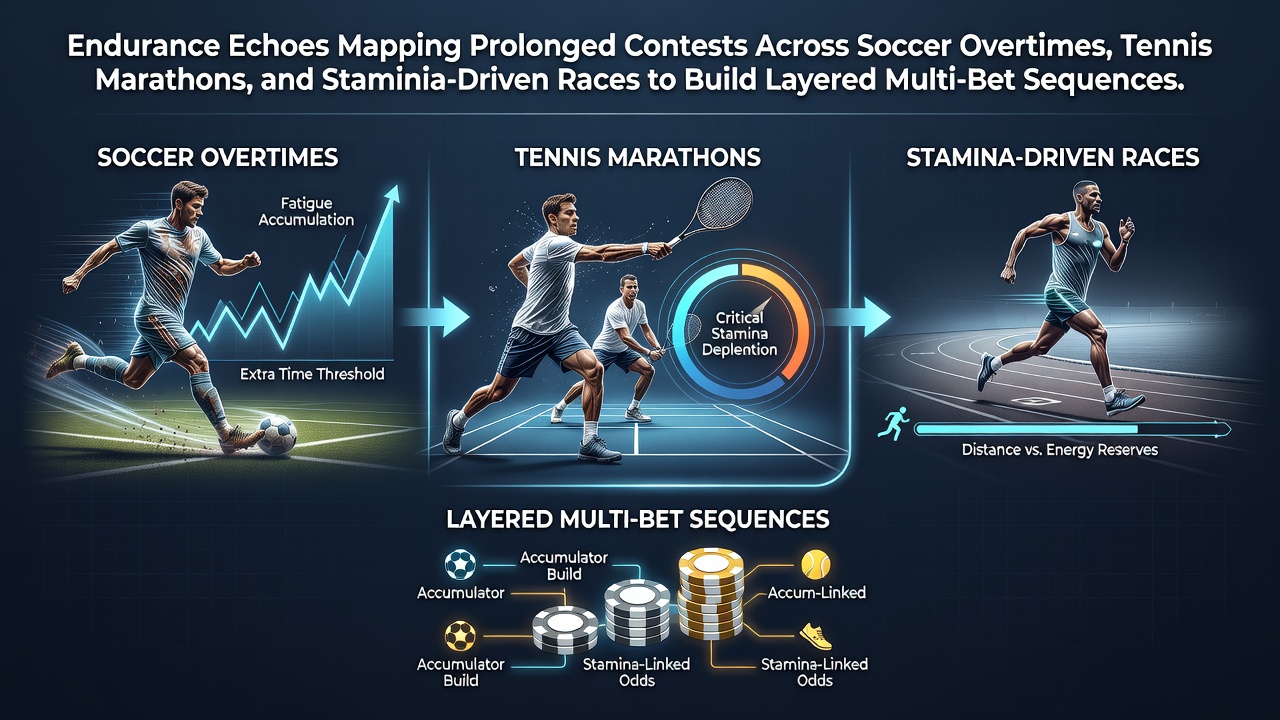
Prolonged contests shape betting markets across soccer, tennis, and stamina-focused races because these events generate distinct statistical patterns that span multiple periods or sets; observers track how overtime goals in soccer, extended sets in tennis, and late surges in distance races create opportunities for sequenced wagers that layer outcomes from each sport into single accumulators.
Soccer Overtimes and Their Statistical Footprint
Soccer leagues and tournaments record overtime periods with measurable frequency, and data from major competitions shows extra-time goals occur at rates that differ from regular play; analysts compile figures from UEFA events and domestic cup ties where matches extend beyond ninety minutes, revealing that defensive setups often tighten while fatigue influences substitution patterns and set-piece success. Those patterns feed into multi-bet construction because bettors can pair an overtime goal expectation with parallel outcomes from tennis or racing, forming layered sequences that accumulate across unrelated fixtures scheduled on the same day or weekend.
Tennis Marathons and Match-Length Distributions
Tennis grand slams produce matches that stretch across five sets and multiple hours, and historical records document several contests exceeding six or seven hours; the 2010 Wimbledon encounter between John Isner and Nicolas Mahut stands as one benchmark, yet subsequent data from the Australian Open and US Open indicate that tiebreak frequency and service-hold percentages shift measurably after the third set. Researchers tracking these durations note that stamina metrics correlate with surface type and player ranking differentials, supplying quantitative inputs for accumulators that combine tennis set-over-total markets with soccer overtime props and race finish-position bets.
Stamina-Driven Races and Late-Stage Dynamics
Horse racing and endurance events emphasize late-race positioning, and timing data from events such as the Melbourne Cup or the Grand National illustrate how pace distributions change in the final furlongs; studies of sectional times reveal that horses maintaining consistent splits through the middle stages post higher win probabilities when the field stretches. These observations translate directly into betting layers because a wager on a strong finisher can sit alongside a soccer overtime goal line and a tennis fifth-set total, creating a sequence whose individual components draw from endurance signals rather than early-match volatility.
Constructing Layered Multi-Bet Sequences
Bettors assemble sequences by identifying endurance thresholds across the three domains and then aligning them within accumulator formats; one approach pairs soccer matches expected to reach extra time with tennis contests showing elevated fifth-set probabilities, then adds a stamina race where sectional data supports a closing surge. Data providers publish historical correlations between these variables, allowing systematic selection of legs whose combined odds reflect measured probabilities rather than isolated outcomes. In September 2026 several major tournaments and autumn race meetings coincide, giving participants concrete calendars on which to test such layered constructions.

Industry reports from organizations such as ATP Tour analytics supply match-duration benchmarks that complement sectional timing released by Australian racing authorities, enabling cross-sport calibration without reliance on single-source metrics. Those who map the data observe that certain combinations recur across seasons because fatigue thresholds align on shared calendar windows.
Practical Examples from Recent Seasons
Take one documented sequence from the 2024 calendar where a Champions League knockout tie reached extra time, a Wimbledon second-week match extended to five sets, and a Royal Ascot handicap featured a pronounced late surge; the three legs combined into an accumulator whose payout reflected the endurance overlays rather than standard win markets. Observers tracking similar alignments in 2025 noted that September fixtures often cluster endurance opportunities because league cups, late-summer slams, and autumn classics overlap. The same mapping process applies when data sets expand to include challenger-level tennis or listed horse races, broadening the pool of candidate legs while preserving the core focus on prolonged effort.
Conclusion
Mapping prolonged contests across soccer overtimes, tennis marathons, and stamina-driven races supplies a factual framework for layered multi-bet sequences; statistical distributions from each sport supply measurable inputs that combine into accumulators whose structure rests on documented endurance patterns rather than conjecture. As calendars for 2026 continue to align these event types, participants retain access to the same quantitative anchors that have characterized prior seasons.