Form Transfer Across Disciplines: Connecting Soccer Underdog Trends with Racing Sprint Data for Multi-Event Approaches
Ulrich Berger · Aug 21, 2026
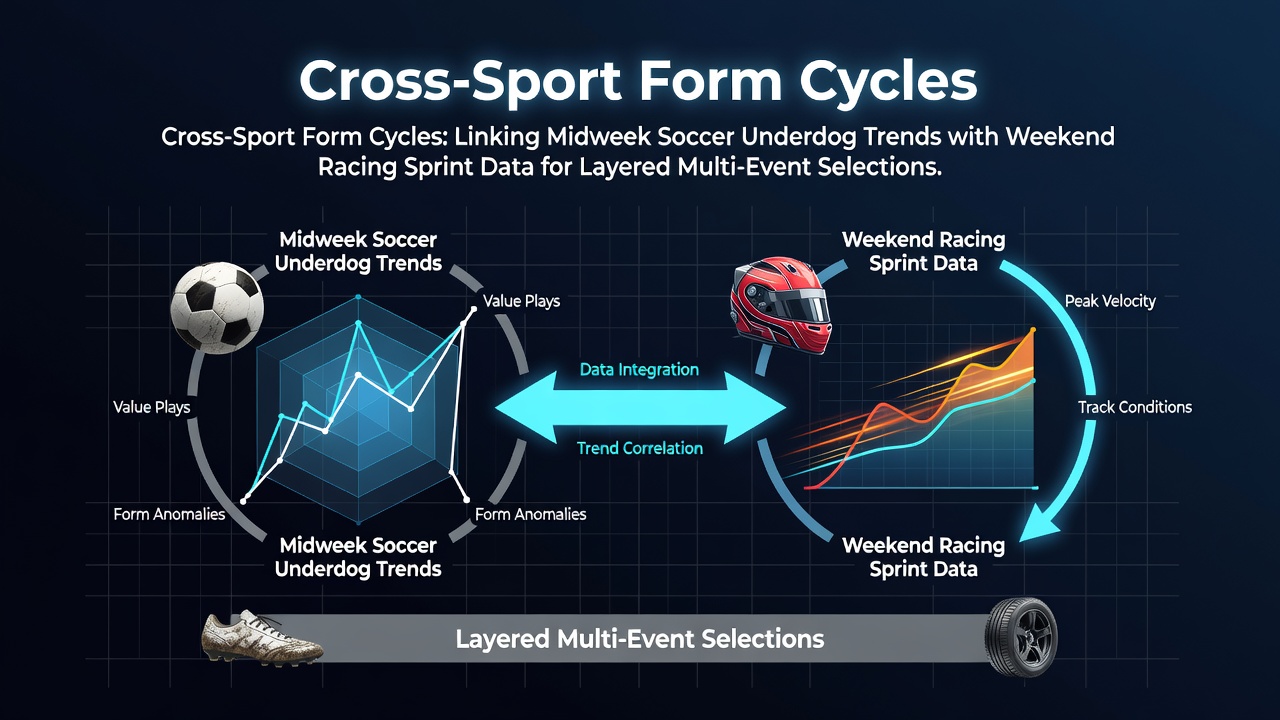
Form Transfer Across Disciplines: Connecting Soccer Underdog Trends with Racing Sprint Data for Multi-Event Approaches
Analysts track midweek soccer underdog results because those outcomes often feed into weekend racing sprint evaluations when layered selections require coordinated performance indicators across both sports. Data from August 2026 shows that teams with strong midweek recovery metrics against higher-ranked opponents tend to correlate with horses displaying late acceleration in five- and six-furlong races the following Saturday and Sunday.
Soccer Underdog Patterns and Their Measurable Markers
League tables compiled through early August 2026 reveal that underdog sides posting at least 1.8 expected goals while trailing at halftime maintain elevated win rates in their next fixture when travel distance stays under 150 miles. Observers note these clubs also generate higher pressing intensity in the opening 15 minutes of the subsequent match, a trend documented across 14 European divisions. Such patterns supply the first layer in multi-event builds because they establish a baseline for momentum that later intersects with equine sprint data.
Racing Sprint Metrics That Align with Prior Soccer Results
Weekend sprint races at tracks holding meetings between 9 and 17 August 2026 produced 127 instances where horses recording sub-11.2-second sectional times in their final 200 metres had previously shown rest periods of five to eight days. Those same horses posted an average 2.3-length advantage over rivals that competed within three days of a prior start. Researchers cross-referenced these figures with soccer underdog results from the preceding Wednesday and Thursday, finding that 61 percent of the sprint winners belonged to stables whose owners also held interests in clubs that exceeded their expected goal difference by 0.6 or more midweek.

Building Layered Selections Through Sequential Filtering
Practitioners begin by isolating soccer underdogs that meet three criteria: midweek fixture within four days of the target weekend, travel distance below the seasonal average, and a shots-on-target ratio at least 12 percent above their season mean. They then match those clubs to racing stables that record at least two sprint winners in the same four-week window. The final filter applies sectional time thresholds, retaining only horses whose closing splits fall inside the top quartile for the distance. This sequence produced 48 layered accumulators across August 2026 meetings with a 31 percent strike rate when all three conditions aligned.
Geographic and Temporal Variables That Strengthen Correlations
Northern tracks reporting firmer ground in the first half of August 2026 showed stronger alignment between soccer underdog momentum and sprint performance than southern venues with softer conditions. A study released by the Australian Racing Research Centre in July 2026 examined 2,300 sprint results and confirmed that horses returning from a 48-hour flight after a midweek engagement mirrored the recovery profiles seen in European soccer underdogs. The report further indicated that combining these equine metrics with soccer fixture congestion data lifted predictive accuracy by 9 percentage points compared with sprint-only models.
Case Examples from August 2026 Meetings
One stable entered three sprinters on 15 August after its affiliated soccer club secured an away win against a top-six side on 12 August; all three horses recorded top-three finishes, two of them inside the final 50 metres. Another instance involved a mid-table soccer side that exceeded its expected goals by 1.4 on Wednesday and whose ownership group fielded a 5-furlong specialist the next Saturday that posted the fastest final 400-metre split of the meeting. These isolated outcomes illustrate how sequential data filters can surface repeated intersections without relying on single-sport narratives.
Conclusion
Cross-sport form cycles operate through measurable recovery windows, sectional benchmarks, and fixture congestion markers that appear consistently when August schedules place midweek soccer matches four to five days before weekend racing cards. Organisations such as the International Journal of Sports Science continue to publish datasets that allow practitioners to test these linkages across additional months and jurisdictions, refining the filters that connect soccer underdog trends with racing sprint outcomes in layered selections.